Neoprene Diaphragms.

Cannon Gasket has the Capability to produce high strength, tear resistant diaphragms for your most critical and demanding applications. Diaphragms are commonly used in high pressure applications where the material must be flexible yet durable enough to withstand repeated flexing over a long period of time. Materials are integrated with reinforcing fabrics to improve application performance and durability, along with Capabilities to maintain responsiveness to variations in pressure. Common Diaphragm Fabrics include; Nylon, Dacron® / Polyester, Nomex®, Kevlar®, Fiberglass, Silk and Cotton. Neoprene (polychloroprene / CR) is a balanced, general-purpose elastomer well suited to diaphragms that must flex repeatedly while resisting moderate oils, weather, and a broad range of chemicals. Cannon Gasket die-cuts neoprene diaphragms, plain or fabric-reinforced, to your pump, valve, or regulator pattern.
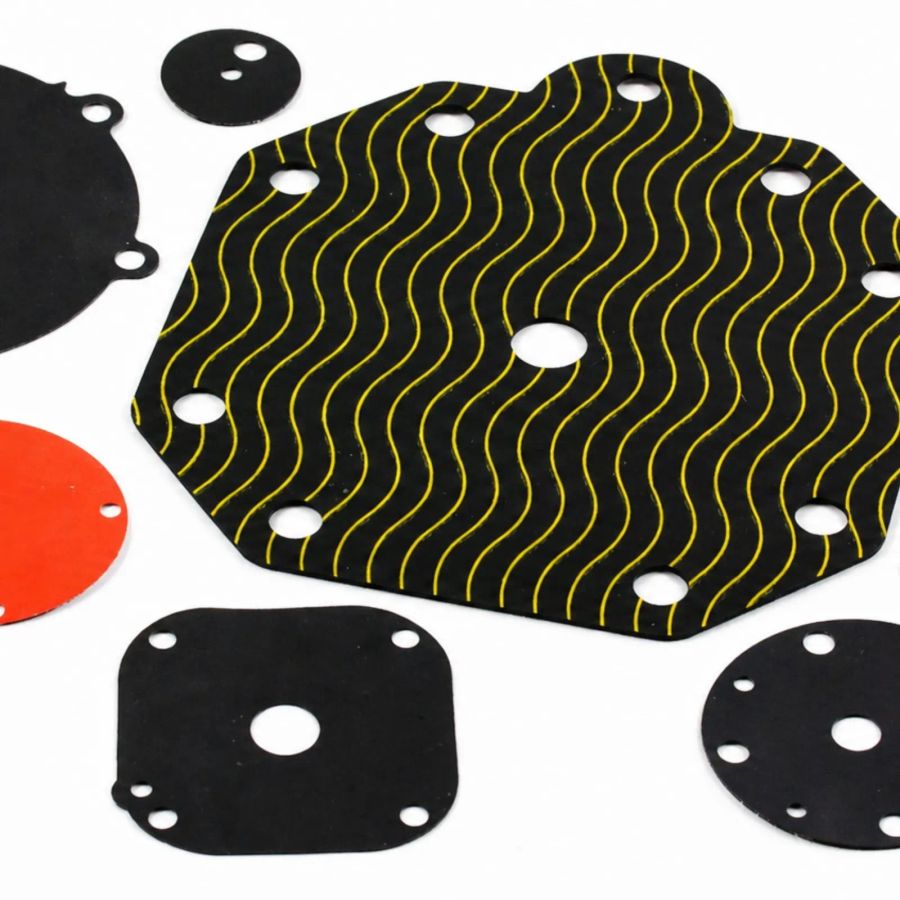
Neoprene diaphragms, die-cut close-up
Get pricing

Request a quote for Neoprene diaphragms.

Properties of Neoprene diaphragms

Cannon Gasket cuts Neoprene diaphragms to your exact specifications. Neoprene exhibits resistance to oils, greases, solvents, and many chemicals, with good weather, ozone, and UV resistance.

Neoprene tolerances and customization

Standard dimensional tolerances on Neoprene diaphragms land around ±0.010" to ±0.015" on OD and ID, depending on material thickness and profile. Tighter tolerances are available on selected grades. Cannon Gasket cuts Neoprene to custom profiles in-house and matches lead times to your production volume. PSA backing, pad printing, custom packaging, and kitting are all on the menu when you need them.

How Neoprene Performs

Its combination of good mechanical strength, resilience, and refrigerant compatibility makes neoprene a common choice for the sensing and working diaphragms in pressure regulators, refrigeration equipment, and general pneumatic controls. As a flexing element, it holds up well to ozone, UV, and repeated pressure cycling where extreme chemical or temperature resistance is not required.

Where Neoprene Diaphragms Are Specified

- Pressure regulator diaphragms - Refrigerant control diaphragms - Pneumatic control diaphragms - Diaphragm pump elements - Air-operated valve diaphragms - Actuator sensing diaphragms

Where Another Material May Fit Better

Neoprene is not recommended where strong acids, oxidizers, or aromatic fuels contact the diaphragm.

Manufacturing Methods

Die-Cut or Flash Cutting available

Frequently Asked Questions

Common Neoprene diaphragm questions.

Are you ISO 9001 certified?
Yes, ISO 9001:2015 certified. Documented quality management covers incoming material verification, in-process inspection, calibrated measurement, final inspection, non-conformance handling, corrective action, and full lot traceability. AS9100-ready for aerospace, with MIL-spec and FDA 21 CFR 177.2600 / USP Class VI grades available on request.
Do you supply fabric-reinforced diaphragms?
Yes. Nylon or polyester fabric embedded in the elastomer adds tensile strength for high-pressure service. Common for hydraulic and pneumatic actuator applications above 100 psi.
What applications use custom diaphragms?
Diaphragm pumps, pressure regulators, pneumatic actuators, control valves, medical devices (ventilators, dialysis, infusion pumps), and pneumatic logic controls. We cut the diaphragm blank to your drawing in any of the stocked compounds.
Which materials are used for custom diaphragms?
Silicone for wide temperature and FDA grades, EPDM for weather and steam, Nitrile / Buna-N for fuel and oil pumps, Viton for aggressive chemicals, Fluorosilicone for aerospace fuel systems, and fabric-reinforced rubber for high-pressure applications.
How fast do you return a quote?
Most RFQs come back within one business day. Simple profile updates to an existing tool quote same-day. Send a drawing, DXF, or competing part number and our engineering team reviews material, tolerance, and volume before pricing.
What is the minimum order quantity?
Minimums depend on the part and material. We cut prototype and first-article quantities for engineering evaluation, then scale up to production volumes from the same tooling. For high-volume programs we run JIT, VMI, and Kanban replenishment out of Fontana, California.
What should I send with an RFQ?
Ideal: a drawing or DXF, material spec (or compound family), estimated annual volume, and any regulatory callouts (FDA, USP Class VI, AS9100, MIL-spec). If you only have a sample or a part number from a competing supplier, send that and we will reverse-engineer the spec before quoting.
What are typical lead times?
Prototype and first-article parts usually ship in 5-10 business days. Production runs from existing tooling are 2-3 weeks depending on volume and material lead time. Rush and expedite options available on a case-by-case basis.
Need custom Neoprene diaphragms?
From prototype to production, any size, any volume.
ISO 9001 CertifiedAS9100-ReadyMIL-Spec CompatibleFDA / USP Class VIEst. 1971ISO 9001 CertifiedAS9100-ReadyMIL-Spec CompatibleFDA / USP Class VIEst. 1971ISO 9001 CertifiedAS9100-ReadyMIL-Spec CompatibleFDA / USP Class VIEst. 1971ISO 9001 CertifiedAS9100-ReadyMIL-Spec CompatibleFDA / USP Class VIEst. 1971