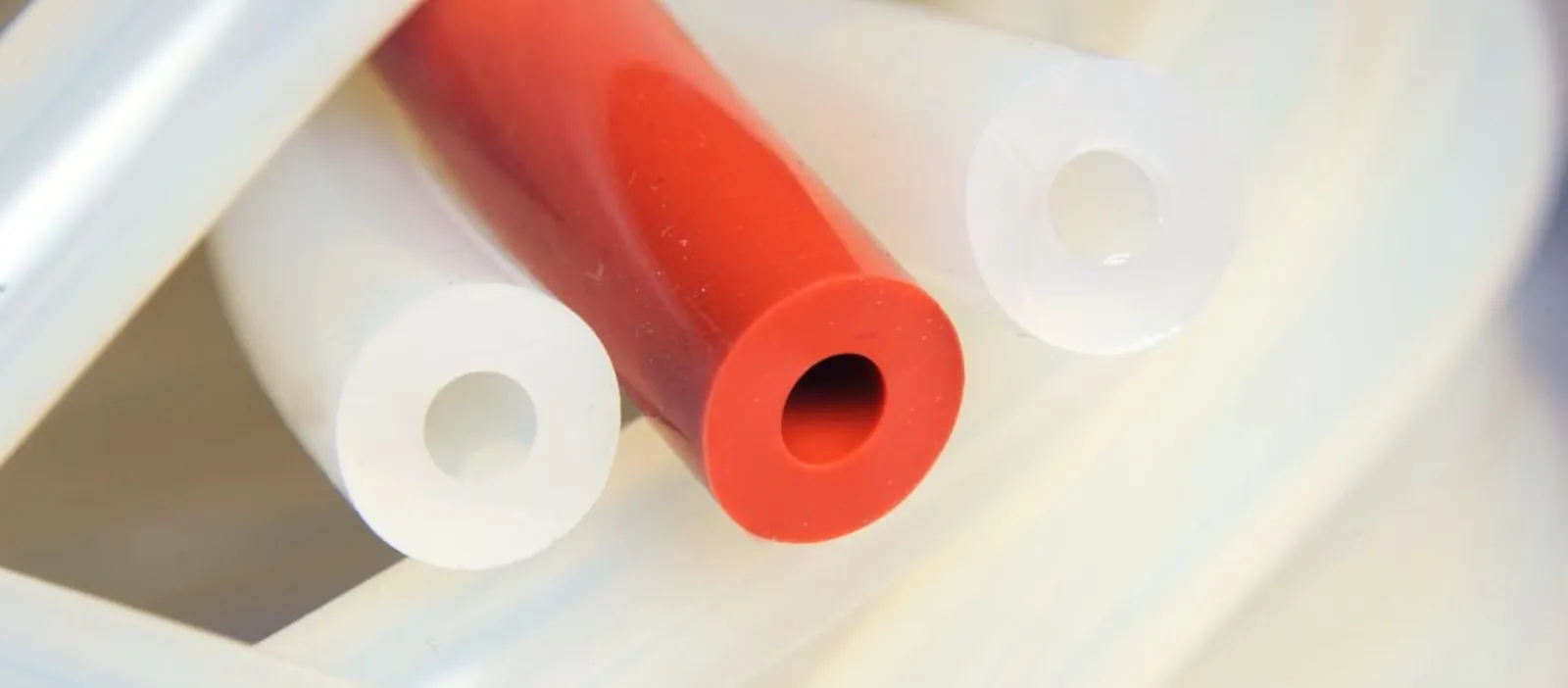
"FDA-grade silicone" gets used as a catch-all on spec sheets, but it is not a single material or a single certification. It is shorthand for silicone rubber that has been formulated, cured, and tested to meet the specific U.S. Food and Drug Administration regulation that applies to its end use, and in medical work, to the relevant USP biological standards as well. For an engineer specifying a seal, a gasket, or a length of tubing, knowing which regulation actually governs the part matters far more than the marketing label. This article covers the standards that define food and medical silicone, the difference between platinum-cured and peroxide-cured compounds, the temperature and durometer ranges you can expect, and where these materials belong in real applications.
What "FDA-Grade" Actually Refers To
Silicone rubber is a synthetic elastomer built on a backbone of silicon and oxygen, with methyl and other organic groups attached. That siloxane structure is what gives silicone its wide service temperature range, its resistance to ozone and UV, and its chemical inertness. None of that, by itself, makes a compound food-safe or biocompatible. A silicone becomes "FDA-grade" only when its base polymer, fillers, pigments, and cure system all fall within the substances the FDA permits for the intended contact.
For food contact, the governing regulation is 21 CFR 177.2600, "Rubber articles intended for repeated use." This section lists the permitted base polymers and the additives allowed in rubber that touches food, and it sets extraction limits. A compliant compound is tested by boiling sample articles in water and in n-hexane and measuring how much material extracts into each. The point of the test is simple: a gasket on a dairy line or a seal in a coffee machine must not leach measurable amounts of itself into the product over repeated use. When a supplier says a silicone "meets FDA 177.2600," that is the claim being made, and it is verifiable through the extractables data.
For medical and pharmaceutical contact, the relevant benchmark is usually USP Class VI, the most demanding of the United States Pharmacopeia's six classes for plastics and elastomers. USP Class VI requires three biological tests on the cured material: a systemic injection test, an intracutaneous (intradermal) test, and an implantation test, each run with specified extraction media. Passing Class VI shows the compound does not produce a toxic or irritant response under those conditions. Many medical silicones are also evaluated against the broader ISO 10993 series for biocompatibility, which covers cytotoxicity, sensitization, and irritation in more depth than USP alone. USP Class VI and ISO 10993 describe biological safety; 21 CFR 177.2600 describes food-contact extractables. A part can need one, the other, or both depending on where it is used.
Platinum-Cured vs. Peroxide-Cured Silicone
The cure system is where a lot of "FDA-grade" parts quietly differ, and it is worth understanding before you specify. Silicone is cross-linked, or vulcanized, by one of two chemistries, and the choice affects purity, byproducts, and cost.
- Peroxide-cured silicone uses an organic peroxide as the cross-linking agent. It is the more economical, longer-established route and is well suited to extrusion and general molded goods. The tradeoff is that the cure leaves behind peroxide decomposition byproducts. Parts almost always require a post-cure (a secondary bake, often several hours at elevated temperature) to drive off those residuals and reduce volatiles before the material is used in sensitive contact. Without an adequate post-cure, peroxide-cured silicone can carry odor and taste and may not pass tighter extractables limits.
- Platinum-cured silicone (also called addition-cure) uses a platinum catalyst to drive an addition reaction between vinyl and hydride groups. The reaction produces essentially no volatile byproducts, so the cured material is cleaner, lower in extractables, and more dimensionally consistent. Platinum-cured grades are the default for pharmaceutical fluid paths, implantable and skin-contact devices, and infant products, because they avoid peroxide residues entirely and hold tighter tolerances. The catalyst is more expensive, and the chemistry is sensitive to certain contaminants (sulfur, amines, tin, and some plasticizers can inhibit the cure), so handling and tooling have to be controlled.
As a practical rule: for repeated-use food gaskets and bakeware-type service, a properly post-cured peroxide grade meeting 21 CFR 177.2600 is often sufficient and cost-effective. For pharmaceutical, diagnostic, and patient-contact parts where USP Class VI and low extractables matter, platinum-cured silicone is the right call. Confirm the cure system on the data sheet rather than assuming, because both can legitimately wear the "FDA-grade" label.
Temperature, Durometer, and Mechanical Range
Silicone's headline property is its temperature band. Standard FDA-grade silicone compounds hold useful elastomeric properties across roughly -50 F to +500 F (about -45 C to +260 C) for continuous service, with specialty grades extending lower or tolerating brief excursions higher. That range is what makes one material practical for a freezer seal and an autoclave gasket alike. Silicone keeps its flexibility at low temperature far better than most general-purpose rubbers, and it resists the heat aging that hardens nitrile or neoprene.
For sealing parts, silicone is typically specified by Shore A hardness, most commonly between 40 and 80 durometer, with 50 and 70 being the everyday choices. Softer grades around 40 to 50 Shore A seal well against imperfect or low-clamp-load flange faces; harder grades near 70 to 80 resist extrusion under higher pressure and handle better in automated assembly. Silicone's compression set resistance is good across that span, so a properly designed gasket holds its seal through repeated thermal cycling rather than taking a permanent set.
The honest limitations matter too. Silicone has lower tensile strength and tear resistance than many organic rubbers, so it is not the right choice for high-abrasion or high-dynamic-stress duty. It also resists water, dilute acids, and many polar fluids well, but it swells in nonpolar hydrocarbons, fuels, and oils. Where a part needs silicone's temperature range plus better fuel and solvent resistance, fluorosilicone is the usual substitute, trading some cost and a slightly narrower temperature band for chemical resistance silicone does not have.
Food and Beverage Applications
In food and beverage processing, FDA-grade silicone shows up wherever a flexible seal has to survive both cleaning heat and product contact. Common uses include gaskets on filler heads and fitting connections, seals in ovens and steam equipment, diaphragms in dispensing and dosing valves, and static gaskets on access ports and sight glasses. The combination that drives the selection is usually the same: the part has to tolerate hot product or steam, withstand clean-in-place cycles and sanitizers, and not transfer odor or taste to the product. A peroxide-cured grade with a full post-cure, certified to 21 CFR 177.2600, covers most of this work. For dairy and 3-A sanitary equipment, additional industry standards on surface finish and design come into play on top of the material certification.
Medical and Pharmaceutical Applications
On the medical side, silicone's biocompatibility and thermal stability make it the default elastomer for a long list of components: tubing and fluid-path seals, peristaltic pump tubing, vial and bottle stoppers, septa, diaphragms, catheter components, gaskets in diagnostic instruments, and seals in respiratory and surgical equipment. Two properties carry most of the load here. First, silicone tolerates repeated sterilization, including steam autoclaving (typically 250 F to 270 F / 121 C to 132 C), gamma irradiation, and ethylene oxide, without the rapid degradation many rubbers show. Second, platinum-cured medical grades pass USP Class VI and ISO 10993 testing, which is what lets them sit in a fluid path or against tissue.
For pharmaceutical packaging, the inertness of the silicone is the whole point: a stopper or seal must not react with the drug product or contribute extractables and leachables that compromise it. This is exactly why platinum-cured, low-volatile compounds dominate that space, and why suppliers document cure system and extractables data rather than relying on a generic "FDA" claim. Many of these parts are produced under controlled conditions; Cannon Gasket runs clean-room stamping (ISO 7, Class 10,000) for medical and FDA-contact parts where particulate control is part of the spec.
Infant and Consumer Products
Pacifiers, bottle nipples, and feeding components rely on platinum-cured silicone for the same reasons medical parts do: low extractables, no peroxide residue, and a clean taste and odor profile. The flexibility and tear behavior have to be tuned for repeated flexing and biting, and the absence of cure byproducts is non-negotiable for anything an infant mouths. These parts are a good illustration of why the cure system, not just the "FDA-grade" label, should drive the specification.
How Compliance Is Documented
Specifying FDA-grade silicone responsibly means asking for the paperwork that backs the label. A complete picture usually includes the base compound's certification to 21 CFR 177.2600 for food contact, USP Class VI and/or ISO 10993 test reports for medical use, the cure system (platinum or peroxide) and post-cure profile, and the durometer and color of the finished compound. Pigments and any secondary additives have to be on the permitted lists as well, since a non-compliant colorant can disqualify an otherwise compliant base. Reputable material suppliers provide this data on the compound data sheet; the fabricator's job is to mold or cut the part without introducing contamination and, where required, to produce it under the right environmental controls.
Choosing the Right Grade for the Job
The short version: match the standard to the contact. Repeated food contact points you to a 177.2600-compliant grade. Patient or fluid-path contact points you to platinum-cured silicone with USP Class VI and ISO 10993 data. Fuel, oil, or solvent exposure alongside silicone's temperature range points you to fluorosilicone instead. And the durometer, color, and cure system all need to be settled before tooling, not after. For a broader comparison against other elastomers and fiber materials, the gasket material selection guide lays out the temperature and chemical tradeoffs side by side.
If you are working out which grade of FDA-compliant silicone fits your part, Cannon Gasket manufactures custom silicone rubber gaskets, FDA medical-grade gaskets, and silicone O-rings for food and beverage and medical device customers. Send us your drawing or your contact and cure requirements and we will recommend a compound, confirm the applicable standards, and quote it. Request a quote or material recommendation and we will follow up with the specifics.