Phenolic Plastic Washers
Phenolic (Bakelite®) is a thermoset laminate built from layers of paper, cotton, glass, or canvas impregnated with phenolic resin and cured under heat and pressure. The result is a hard, strong, dimensionally stable plastic that retains its strength and electrical insulating properties at temperatures where most thermoplastics would soften. Cannon Gasket die-cuts and machines custom phenolic washers for transformer insulation, electrical assemblies, and structural fastener applications.
- Highlight
- High compressive strength
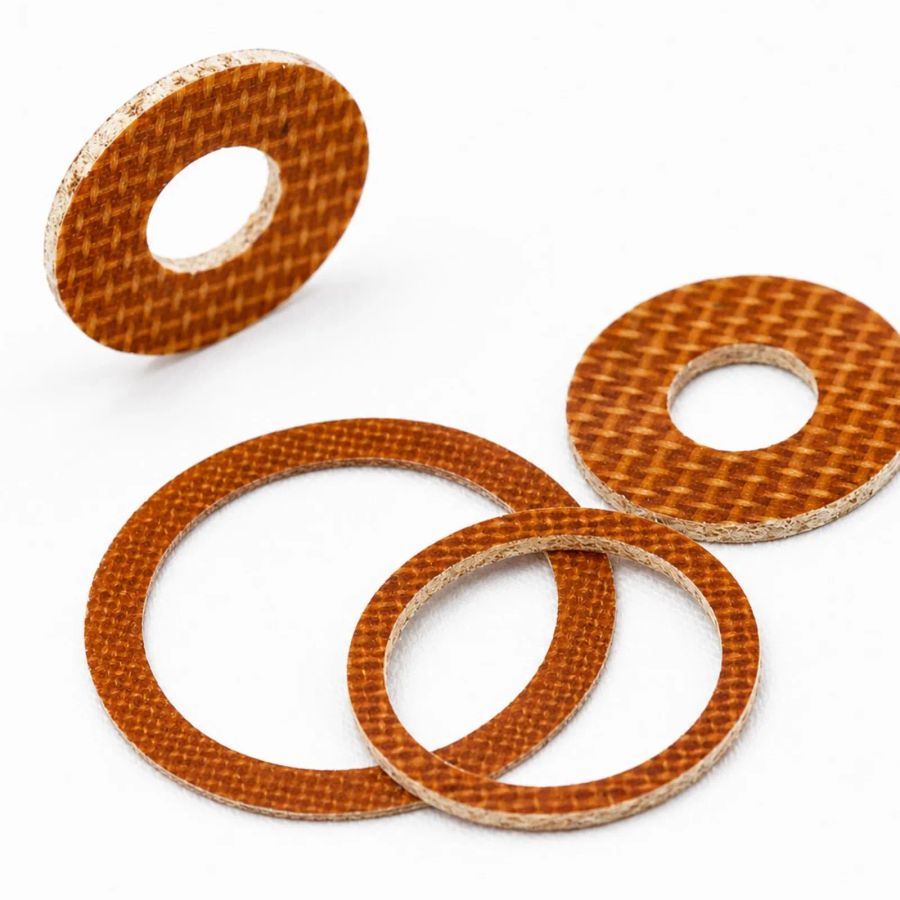
Request a quote for Phenolic plastic washers.
Properties of Phenolic plastic washers
Cannon Gasket cuts Phenolic plastic washers to your drawing. Good resistance to oils, solvents, and many chemicals. Excellent electrical insulation (NEMA grades available). Not suitable for strong alkalis.
Phenolic tolerances and customization
Standard dimensional tolerances on Phenolic plastic washers land around ±0.010" to ±0.015" on OD and ID, depending on material thickness and profile. Tighter tolerances are available on selected grades. Cannon Gasket cuts Phenolic to custom profiles in-house and matches lead times to your production volume. PSA backing, pad printing, custom packaging, and kitting are all on the menu when you need them.
How Phenolic Performs
- Excellent dielectric strength — premier electrical insulator. - High mechanical strength and dimensional stability. - Resistant to oils, solvents, and weak acids. - Available in grades: paper-base (X, XX, XXX), cotton-cloth-base (C, CE, L, LE), glass-cloth-base (G3, G7, G10, G11), and Nomex-base.
Common Washer Applications
Transformer and electrical equipment insulator washers, motor and generator slot insulation, switchgear and circuit breaker spacers, structural fastener washers requiring electrical isolation, thermal barriers, and aerospace electronics.
When to Choose Another Material
For lower humidity sensitivity, glass-base phenolic (G10) over paper-base. For paper-format flexibility, Nomex.
Manufacturing Methods
Die-cut and compound-die-cut. CNC-machined
Manufacturing, finishing & stocking
Precision & tooling: Capable of holding tolerances as tight as ±.001" on critical dimensions when required, beyond the ±0.010" to ±0.015" standard. Short- and long-run capabilities, with an extensive in-house tooling inventory for rapid turnaround.
Clean room: Cannon Gasket offers clean-environment stamping for medical, FDA, electronic, and scientific applications where a controlled level of particulate is required, with capabilities to meet ISO Class 10,000.
Stocking agreements: Blanket orders, VMI (vendor-managed inventory), JIT (just-in-time), and Kanban replenishment programs.
Pad printing: Pad print your part number, identification marking, or company name in a range of ink colors. Marking per customer specifications or MIL-STD-130.
Packaging: Parts are bagged and tagged in specified quantities and labeled with P/N or any required information. Capability to meet specific packaging and labeling requirements.