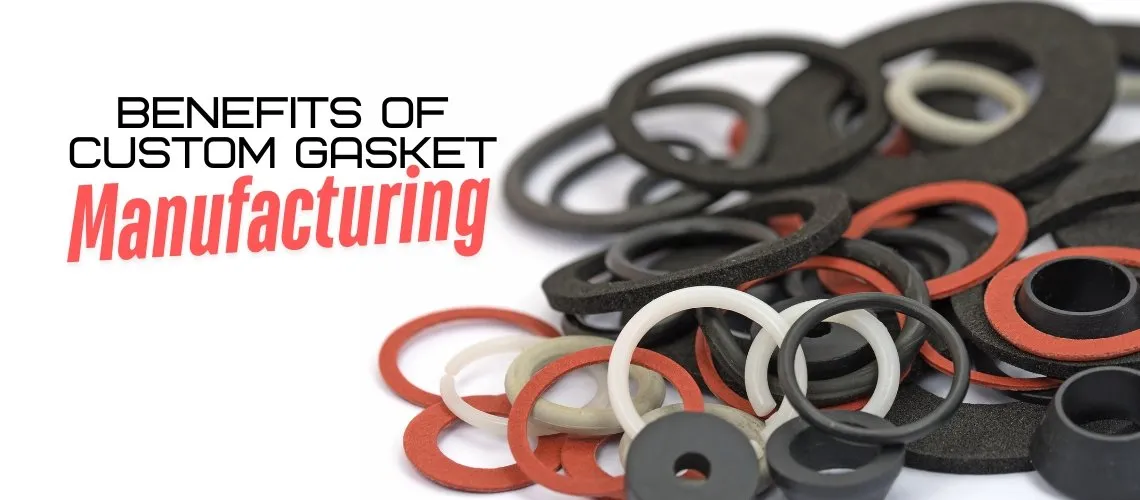
Oil and gas service punishes a gasket from every direction at once: sour gas, hot hydrocarbons, steam, amines, thermal cycling, and flange loads that change every time a unit comes up to temperature. An off-the-shelf gasket sized for a generic flange rating rarely matches the exact bolt load, media, and temperature a real wellhead, separator, or pipeline valve sees. Custom gasket manufacturing lets you specify the compound, thickness, and geometry around the actual operating envelope instead of forcing the joint to accept whatever is on the shelf. Below are five concrete reasons that matters, with the materials and standards that engineers in this field actually reference.
1. The right compound for the media, not a generic stock pick
The single most common failure in oil and gas sealing is an elastomer or fiber that was never rated for the media in the line. The clearest example is silicone. Silicone is an excellent high-temperature seal for dry air, hot gases, and FDA food and pharmaceutical use, but it swells and degrades badly in hydrocarbons and is a poor choice for oil and gas process service. Specifying it for a fuel or crude line is a mistake you only make once.
Custom manufacturing means the compound is matched to the stream:
- FKM (Viton) is the workhorse for refined fuels, crude, and aromatic hydrocarbons, with continuous service to roughly 200 C (400 F). Standard FKM grades do not love steam, hot amines, or high-pH fluids, so the grade has to suit the duty.
- HNBR handles hydrocarbons plus light sour service and amine corrosion inhibitors better than standard nitrile, with continuous service to about 150 C (300 F) and good resistance to rapid gas decompression when properly compounded.
- Aflas (FEPM) is the choice for hot sour gas, steam, amines, and high-pH chemicals where FKM falls short, with service to roughly 200 to 230 C.
- Flexible graphite seals high-temperature, high-pressure flanges and survives fire exposure, holding up well past 450 C in flange service and far higher in inert conditions.
- PTFE is chemically near-inert across about -200 C to 260 C, ideal for aggressive chemistry, though its tendency to cold-flow under load has to be designed around.
- Compressed non-asbestos fiber covers general flange duty across a broad range of hydrocarbons and utilities, typically to around 400 C depending on the grade and binder.
You can compare specifics on the Viton (FKM) gasket, flexible graphite gasket, and compressed fiber gasket pages.
2. Sour service that actually meets NACE MR0175
Any well or facility producing hydrogen sulfide (H2S) is sour service, and the governing reference is NACE MR0175 / ISO 15156, which sets material requirements for resistance to sulfide stress cracking and related H2S damage. Sour service is what disqualifies a lot of stock parts. Standard nitrile hardens and cracks in H2S; many general-purpose FKM grades are not suited to wet sour environments either.
Custom manufacturing lets you pin down a compound and hardness verified for the H2S partial pressure, temperature, and pH of the specific stream rather than a vague claim of chemical resistance. For elastomer seals that means selecting HNBR or Aflas grades qualified for sour and amine exposure, and for flange gaskets it means flexible graphite or a fiber grade rated for the service. Naming the standard on the print, with the H2S concentration and the temperature band, is what turns chemical resistance from a marketing line into a specification a metallurgist can sign off on.
3. Geometry built around the real bolt load and pressure class
Sealing is about contact stress, not just material. A gasket needs enough seating stress to conform and then enough residual load under operating pressure and temperature to stay tight. Stock gaskets are cut to nominal flange dimensions and assume textbook conditions. Real flanges have their own pressure class, bolt pattern, surface finish, and thermal growth.
Custom work lets you set thickness, width, and profile to the actual joint:
- Nonmetallic flat gaskets are designed and dimensioned per ASME B16.21, and ring-type and spiral-wound joints follow ASME B16.20, so the part matches the flange standard the piping was built to.
- Wellhead and Christmas-tree equipment built to API 6A and pipeline valves to API 6D carry pressure ratings into the thousands of psi (commonly 2,000 to 20,000 psi working pressure), and the seal geometry has to suit that class.
- O-ring and seal sizing follows the AS568 standard so a custom groove design uses dimensions a maintenance team can actually source and replace.
Specifying durometer matters here too. A 70 to 75 Shore A elastomer is a typical flange and o-ring starting point; softer compounds conform on rough or low-load flanges, harder compounds resist extrusion at higher pressure. Dialing that to the joint is exactly what a stock catalog cannot do.
4. Temperature and fire performance you can defend
Oil and gas equipment swings through wide temperature ranges, from cold startups to process streams well over 200 C, and joints have to hold through every thermal cycle. Picking a single number is not enough; the seal has to keep adequate residual seating stress at the high end and stay flexible enough not to crack at the low end.
Custom material selection lets you bracket both ends of the range with one informed choice. Flexible graphite and PTFE cover the high and chemically aggressive end. HNBR and FKM cover the elastomeric sealing range with good compression set resistance when the grade is right. For valves where fire exposure is a credible hazard, the assembly may need to pass a fire test such as API 607 / API 6FA, which favors graphite and metal-reinforced constructions that keep sealing after the elastomer burns away. Matching the gasket to a tested fire-safe design is a safety decision, not a preference.
5. Fewer failures, fewer change-outs, lower lifetime cost
A gasket is a small fraction of a flange assembly's cost and a large fraction of its unplanned downtime risk. A leak in sour or flammable service is a safety and environmental event, not just a maintenance ticket. The economic case for custom gaskets is straightforward: a correctly specified seal that holds through its service interval avoids emergency shutdowns, lost production, fugitive emissions, and repeat repairs on the same joint.
Custom manufacturing also simplifies inventory. Instead of stocking several near-miss stock sizes and hoping one fits, a facility can carry the exact part numbers its flanges and valves actually use, with the compound and dimensions already proven on that equipment. Over a turnaround cycle, fewer surprise leaks and a cleaner spares list usually outweigh the higher unit cost of a made-to-spec part.
How the materials line up against oil and gas duty
A quick reference for matching compound to service:
- Refined fuels, crude, aromatics: FKM (Viton), to ~200 C.
- Light sour gas, amine inhibitors: HNBR, to ~150 C; confirm against NACE MR0175.
- Hot sour gas, steam, high-pH, amines: Aflas (FEPM), to ~200 to 230 C.
- High-temperature, high-pressure, fire-exposed flanges: flexible graphite.
- Aggressive chemistry, broad temperature range: PTFE, ~-200 C to 260 C.
- General flange and utility duty: compressed non-asbestos fiber.
- Not for hydrocarbon process service: silicone, which belongs in dry-heat and FDA applications instead.
If you are specifying gaskets or seals for sour service, high-pressure flanges, or valves with a fire-safe requirement, send us the media, the H2S level if any, the temperature and pressure class, and the flange or groove standard. We will recommend a compound and geometry matched to that duty and the relevant API, ASME, and NACE references. Start with our oil and gas sealing overview, or read more on the role of gaskets in oil and gas, then send your specifications when you are ready for pricing and lead times.