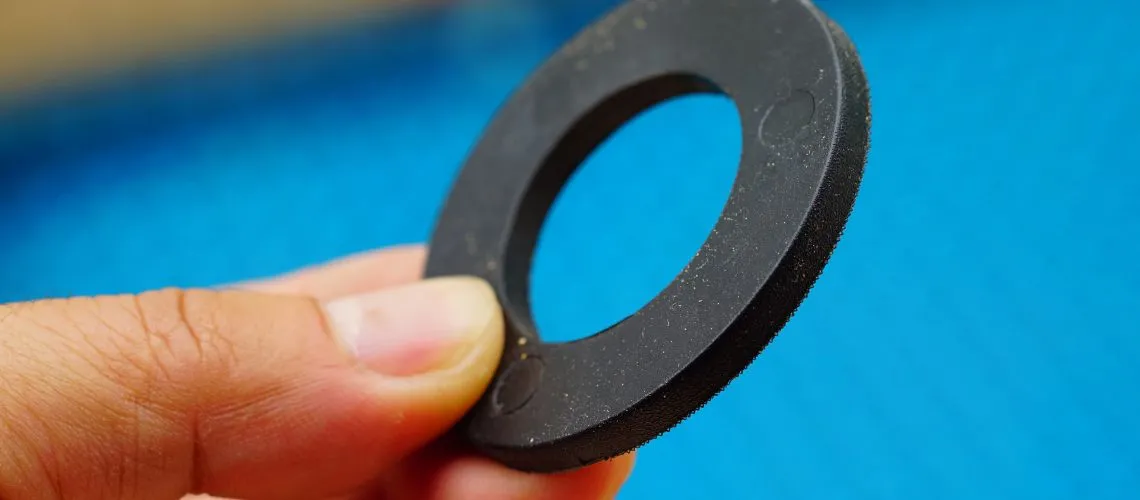
Polyurethane gets specified for washers when a part has to survive wear that would chew through standard rubber. As a flat sealing and load-spreading element, a polyurethane washer sits somewhere between a soft elastomer and a rigid plastic: it deflects under load like rubber, but it resists abrasion, tearing, and cut-through far better. That combination is why the same part shows up under a truck suspension, inside a conveyor, on a fastener exposed to grit, and in a hydraulic assembly. The application list is long, but the reason is always the same set of measurable properties.
What polyurethane actually brings to a washer
Cast polyurethane (often shortened to PU or PUR) is available across a wide hardness band, and that range is what makes one material cover so many jobs. Cannon Gasket cuts polyurethane washers from roughly 60A to 95A Shore hardness. At the soft end, near 60A to 70A, the washer behaves like a firm rubber and is useful for cushioning, vibration damping, and conforming to a slightly uneven mating surface. At the hard end, 90A to 95A and into the low Shore D range, it behaves almost like a tough plastic and is used as a wear pad, a backup ring, or a load-bearing spacer that has to hold dimension under clamp force.
The mechanical numbers are where polyurethane separates itself:
- Abrasion resistance. Polyurethane outlasts most conventional rubbers under sliding, scuffing, and particle wear. In side-by-side abrasion testing it routinely outwears natural rubber and SBR by a wide margin, which is the main reason it is chosen for gritty, high-cycle service.
- Tear and cut resistance. High tear strength means a polyurethane washer resists nicks propagating into a split. Where a softer rubber washer would start to tear at a bolt edge or a sharp corner, polyurethane holds.
- Load capacity and resilience. Polyurethane carries high compressive load without permanently flattening, then springs back. That lets one washer act as both a seal and a structural cushion.
- Oil, ozone, and oxygen resistance. Polyurethane has good resistance to petroleum oils and greases, and it resists ozone and oxygen aging better than many general-purpose rubbers, so it does not crack with age the way exposed natural rubber can.
Temperature and chemical limits
Polyurethane is a workhorse, not a high-temperature material. A practical service range for standard cast polyurethane washers is about -30°F to +200°F (-34°C to +93°C). It stays flexible and tough through that band, but it is not the right call above roughly 200°F, where it begins to soften and lose mechanical strength.
Chemistry sets the other boundary. Polyurethane handles oils, greases, oxygen, and ozone well, but it is not recommended for hot water, steam, or concentrated acids. Polyester-based polyurethanes in particular are vulnerable to hydrolysis, meaning prolonged exposure to hot, humid, or wet conditions breaks the polymer down over time. For continuous hot-water or steam contact, a different elastomer such as EPDM is the better choice; for high heat, silicone. Matching the material to the fluid and temperature up front is what keeps a washer from failing early.
Where polyurethane beats rubber
The honest comparison helps an engineer decide. Standard rubber washers in nitrile, neoprene, EPDM, or SBR are excellent for static sealing and lower-cost general service. Polyurethane earns its place when the washer has to do more than sit still and seal. Choose polyurethane over rubber when:
- The washer slides, rotates, or sees repeated impact and the failure mode is wear, not just compression.
- Abrasive media (sand, ore, dust, metal chips) are in contact and a softer rubber would erode.
- The part carries real compressive load and must hold thickness without taking a permanent set.
- Cut-through at a fastener edge or sharp lip is a concern and high tear strength matters.
Where the job is purely a static gasket-style seal at moderate load, or where hot water, steam, or aggressive chemicals are present, conventional rubber or a specialty elastomer usually wins on cost or chemical fit. Polyurethane is the answer to wear and load, not to heat or harsh chemistry.
Automotive and transportation
In vehicles, polyurethane washers and bushings show up in suspension components, engine and transmission mounts, and brake hardware. The draw is the material's ability to absorb vibration and shock while shrugging off road grit, oil, and ozone. A polyurethane suspension washer or isolator damps noise and harshness yet resists the wear and chemical exposure that degrade rubber over a vehicle's life. Harder grades are used as wear pads and load-spreading washers where steel-on-steel contact needs a tough, replaceable buffer. See where these parts fit in the automotive industry.
Mining, material handling, and heavy equipment
This is polyurethane's home turf. Conveyor systems, ore handling, screening equipment, and heavy machinery expose washers and wear parts to constant abrasion and impact. Polyurethane's abrasion resistance and load capacity translate directly into longer service intervals and less downtime than rubber or even some metal parts in the same spot. Wear washers, load pads, and isolation washers cast or die-cut from 85A to 95A polyurethane absorb impact and resist the gouging that destroys softer materials, which is why heavy equipment and material-handling builders specify it so heavily.
Industrial machinery
On production equipment, polyurethane washers handle sealing, vibration damping, alignment, and wear-pad duty in one part. They reduce friction and chatter at moving interfaces, hold alignment under clamping load, and resist the oils and greases common around machinery. Because polyurethane resists abrasion and oil at once, a single washer often replaces a rubber damping pad and a separate wear part, simplifying the assembly and extending equipment life.
Fastening, structural, and outdoor assemblies
Under bolts and at structural connections, a polyurethane washer spreads clamp load, seals against moisture and air movement, and resists the cut-through that high bolt tension can cause in a softer washer. Its resistance to ozone, oxygen, and weathering makes it suitable for outdoor use where rubber would surface-crack with UV and age. Roofing fasteners, equipment skids, panel mounting, and exterior HVAC and enclosure hardware all use polyurethane washers for a durable, weather-stable seal that holds its set under sustained load.
Fluid systems, electronics, and agriculture
Polyurethane's good oil resistance and tight, resilient seal suit it to many fluid-handling connections involving petroleum-based fluids, hydraulics, and air, though hot-water and steam lines call for a different elastomer. In electronics and appliances, polyurethane washers provide electrical isolation and act as non-marking, moisture-resistant cushions and standoffs that damp vibration without conducting current. In agriculture, the same wear and impact resistance that suits mining carries over to tractors, harvesters, sprayers, and irrigation hardware, where washers see constant grit, vibration, and outdoor exposure and still need to last a season.
Specifying a polyurethane washer
Getting the right part comes down to a few decisions: the hardness that fits the duty (softer for cushioning and conforming, harder for wear and load), the temperature and chemical exposure the washer will see, and the dimensional tolerance the assembly needs. Cannon Gasket die-cuts custom polyurethane washers to your ID, OD, and thickness, with in-house tooling, pressure-sensitive adhesive backing when needed, and runs from prototype quantities through production. If you are unsure whether polyurethane or another compound is the right fit, send the operating conditions and we will help match the material to the application. Request a quote with your specifications and we will respond with pricing and lead time.