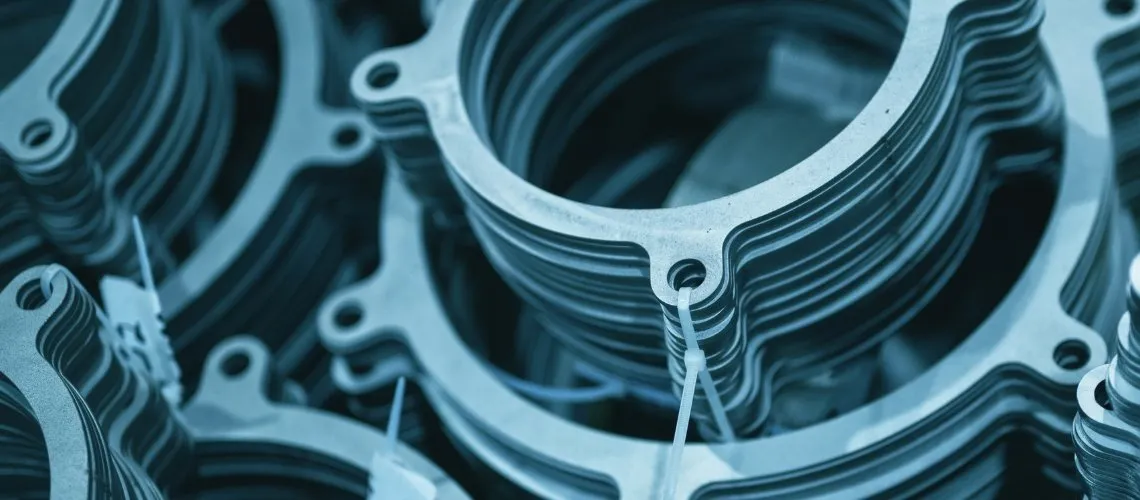
A gasket is a sacrificial part. It is meant to deform under bolt load, fill the imperfections in two mating flange faces, and hold a seal across temperature swings, pressure cycles, and chemical attack for the service life of the joint. Choose the wrong type or material and the gasket either leaks on day one or fails quietly months later, often taking the surrounding equipment with it. This guide covers how industrial gaskets are made, the material families that determine where each one belongs, and the four variables that should drive every selection decision.
How Gaskets Are Manufactured
The manufacturing method matters as much as the material. The same sheet of EPDM can become a flat flange gasket, a precision washer, or a complex multi-bolt cover, and each route has different tolerance and cost tradeoffs.
Die-Cut Gaskets
Die cutting presses a steel rule or matched-metal die through sheet stock to blank out flat parts. It is the workhorse process for non-metallic gaskets: rubber, fiber, cork, foam, PTFE, and paper sheet all cut cleanly this way. Steel-rule dies are inexpensive and turn around fast, which makes them the right call for prototypes and small-to-medium runs. For tight tolerances or high volume, matched-metal (class A) dies hold roughly plus or minus 0.005 in. and produce burr-free edges. Die cutting handles internal bolt holes, slots, and irregular outlines in a single stroke, so a 12-bolt flange gasket comes off the press as one finished part. See our overview of the die-cut gasket process for how tooling is selected by run size.
Lathe-Cut Gaskets and Washers
Lathe cutting parts off rings from an extruded or molded tube of elastomer on a rotating mandrel. It produces seamless, homogeneous rings without the flash line of a molded O-ring or the scrap web of a die-cut part, and it is economical for medium runs of round seals where a molding tool would be overkill. Wall thickness, ID, and OD are all adjustable from the same tube stock. This makes lathe cutting a good fit for custom rubber washers and ring gaskets in sizes that fall between standard O-ring dash numbers. Our lathe-cutting capability page covers the size envelope.
Molded and Spiral-Wound Gaskets
Two methods sit outside Cannon's non-metallic die- and lathe-cut work but are worth understanding for context. Compression and injection molding form elastomer parts in a cavity tool, which is how O-rings to AS568 dash sizes and complex three-dimensional seals are produced at volume. Spiral-wound gaskets, by contrast, are a semi-metallic construction: a V-shaped metal strip (commonly 304 or 316L stainless) is wound in alternating plies with a soft filler such as flexible graphite or PTFE. They are built to ASME B16.20 for raised-face and ring-type-joint flanges and are chosen for high-pressure, high-temperature steam and hydrocarbon service where a soft-cut gasket would blow out. If your joint genuinely needs a spiral-wound or metal ring gasket, that is a different product class from the soft sheet gaskets covered below.
Gasket Material Families and Where They Fit
For flange and cover sealing below roughly 800 to 1,000 psi, the gasket is almost always cut from a sheet material. The material sets the temperature ceiling, the chemical compatibility, and the compliance status of the joint. Below are the families used most in industrial service, with the practical numbers that matter at selection time. Durometer figures are Shore A unless noted.
Elastomers (Rubber Sheet)
- Nitrile (Buna-N): The default for oil, fuel, and hydraulic service. Excellent resistance to petroleum-based fluids; continuous-use range about -40 to 250 F. Poor with ozone, weather, and ketones. Typical sheet runs 50 to 70 durometer. See Buna-N nitrile gaskets.
- EPDM: The choice for water, steam, glycol, and outdoor exposure. Strong ozone, UV, and weathering resistance and a range of about -40 to 300 F. Not compatible with petroleum oils or fuels. See EPDM gaskets.
- Silicone: Wide temperature span, roughly -75 to 450 F, with good ozone resistance and flexibility at low temperature. Mechanically weaker and not for abrasion or most hydrocarbons. FDA-grade silicone meeting FDA 21 CFR 177.2600 and USP Class VI is the standard pick for food, beverage, and medical contact. See silicone gaskets.
- Fluorocarbon (Viton): The premium elastomer for aggressive chemicals, fuels, and heat. Handles about -15 to 400 F (specialty grades lower) and resists a broad range of acids, fuels, and solvents that destroy nitrile. Specified where chemical attack and temperature occur together. See Viton gaskets.
- Neoprene: A balanced general-purpose elastomer with moderate oil resistance, good weathering, and a range near -40 to 250 F. A common low-cost choice for HVAC and enclosure sealing. See neoprene gaskets.
Compressed Fiber and Composite Sheet
Non-asbestos compressed fiber (aramid or glass fiber bound with NBR or SBR) replaced asbestos sheet for steam, water, oil, and general chemical service. It tolerates higher seating stress than soft rubber and handles temperatures up to roughly 700 F and pressures into the hundreds of psi depending on grade. Branded sheets such as Klingersil carry published p-T (pressure-temperature) diagrams that should be checked against the actual joint conditions rather than assumed. Compressed fiber needs adequate bolt load to seal, so it suits rigid metal flanges rather than thin or warped covers. See compressed fiber gaskets and Klingersil gaskets.
PTFE and Flexible Graphite
PTFE (virgin or filled) is the answer for broad chemical resistance, including strong acids and caustics that attack every elastomer, across roughly -350 to 500 F. It cold-flows under sustained load, so filled or expanded grades are used where creep relaxation is a concern. Flexible graphite seals very high temperatures, up to about 850 F in air and far higher in non-oxidizing atmospheres, and is common as a filler in semi-metallic gaskets and as a standalone sheet for steam and exhaust. See graphite gaskets.
Cork, Cork-Rubber, Felt, and Paper
These low-load materials seal where flange pressure is light and surfaces are uneven. Cork-rubber conforms well and is common for transformer covers, oil pans, and electrical enclosures. Felt wicks and retains lubricant for dust and oil retention on rotating equipment, and cellulose or vegetable-fiber paper handles light-duty fuel, oil, and water at low temperature and pressure. They are inexpensive and forgiving, but not for high heat, high pressure, or aggressive chemistry. See cork-rubber gaskets and felt gaskets.
The Four Variables That Drive Selection
Most gasket failures trace back to one of four conditions being out of range. Specify the gasket against all four together, because the material that wins on one can lose badly on another.
- Temperature. Use the actual continuous operating temperature, not the nameplate average, and account for excursions and CIP (clean-in-place) cycles. Match it against the material's continuous-use ceiling with margin: silicone for cold and wide swings, fluorocarbon or graphite for sustained heat, EPDM for steam.
- Media. Identify every fluid the gasket contacts, including cleaning chemicals and trace contaminants. Petroleum points to nitrile or fluorocarbon; water, steam, and glycol point to EPDM; aggressive acids and solvents point to PTFE or fluorocarbon. A gasket that is right for the process fluid but wrong for the CIP caustic will still fail.
- Pressure and bolt load. The gasket must seal at the available seating stress without blowing out at operating pressure. Soft rubber suits low pressure and light flanges; compressed fiber and semi-metallic constructions carry higher pressure but demand more bolt load and rigid flanges. ASME B16.21 covers dimensions for non-metallic flat gaskets used on B16.5 flanges.
- Compliance. Regulated service drives the material as hard as the physics. Food, beverage, and pharmaceutical contact calls for FDA 21 CFR 177.2600 and often USP Class VI elastomers. Oil and gas wellhead and pipeline joints reference API 6A and API 6D, fire-safe valve testing under API 607, and sour-service metals under NACE MR0175. Confirm the governing standard before the material, because it can rule options out entirely.
Matching the Gasket to the Industry
The same selection logic plays out differently by sector. Food and beverage processors lean on FDA silicone and EPDM for hot water and CIP cycles. Chemical and petrochemical plants reach for PTFE, fluorocarbon, and graphite to survive aggressive media and heat. Power generation and steam systems combine compressed fiber and flexible graphite for high-temperature flanges. Electronics and enclosure work uses cork-rubber, foam, and conductive elastomers for environmental and EMI sealing. The full range of sectors we cut for is on our industries page, and our gasket material selection guide walks through narrowing the choice step by step. If you are deciding between a ring gasket and an O-ring for a given groove, the O-ring versus gasket comparison covers that tradeoff.
Build It to Your Spec
Cannon Gasket has die-cut and lathe-cut non-metallic gaskets and washers to customer drawings since 1971, across every elastomer, fiber, and composite sheet covered above. Send a print, a sample, or just the operating temperature, media, pressure, and any compliance requirement, and we will recommend the material and cut method that fits the joint. Browse the full gasket material lineup or reach out with your application and we will respond with material options, pricing, and lead time.